
Nonprofits Create Community is NIA’s theme for 2026, as we celebrate the ways that nonprofits come through for their communities in spite of all the challenges facing them. In this series, meet some NIA-insured nonprofits who share their stories of creating community in their own words.
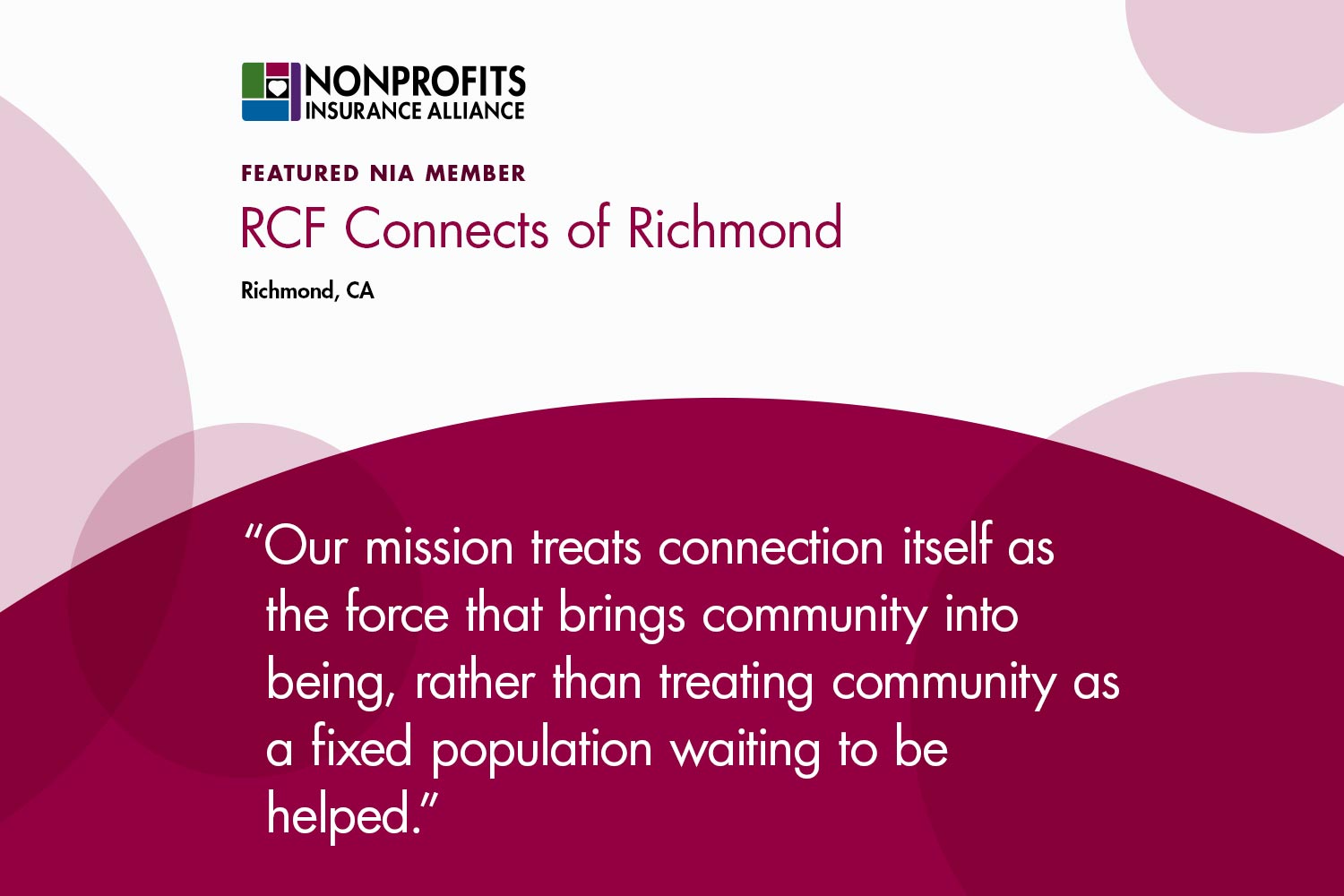
Meet RCF Connects of Richmond, CA
Kimberlli Walker, Development Manager of RCF Connects, explains:
“RCF Connects’ mission is to mobilize the power of connection to build healthy, thriving, and equitable communities.”
How does your nonprofit and your mission create community for the people and places you serve?
Creating collaboration with the people, places, and resources that inequity has kept apart.
“RCF Connects does not describe itself as serving a community that already exists; it mobilizes the power of connection to build healthy, thriving, and equitable communities. This distinction is the whole of it. Community is not the backdrop of the work; it is the product of it.
Our mission treats connection itself as the force that brings community into being, rather than treating community as a fixed population waiting to be helped.
Our conviction expresses itself across Contra Costa County in several ways. It connects a map that history treated as separate. When the Richmond Community Foundation became RCF Connects in 2019, the change reflected a recognition that families were moving east to Antioch, Pittsburg, and Bay Point carrying new needs and new possibilities with them.
Rather than remaining anchored in West County, the organization redrew its own geography to encompass all of Contra Costa.
‘Place,’ in this mission, is not a single neighborhood, but an entire county stitched into one shared community that had not fully recognized itself as connected before.
We connect people to power, not merely to services. RCF Connects envisions an equitable society where people thrive, build, and share power, and reach their full potential, and it pursues that vision by centering community-driven solutions and cultivating the belonging and connectedness that shifts traditional philanthropy toward something transformational.
That language of belonging is where mission becomes community: it names not just an outcome, but a felt experience.
We provide resources to the people that systems have bypassed. This is where equity does its work.
The Equity for Black Women & Girls initiative exists precisely because Black women entrepreneurs receive less than one percent of county funding, and programs such as Sister Circles create safe, supportive spaces for Black women and girls to connect, heal, and lead.
Here, community is built deliberately, in the very places where connection has been withheld.
In addition, we connect stakeholders who would not otherwise share a table.
Acting as a backbone organization, RCF Connects convenes residents, nonprofits, thought leaders and civic leaders around a shared set of goals, and the act of convening is itself the making of community.
Our mission, in the end, creates community by making connection the strategy. RCF Connects creates collaboration with the people, places, and resources that inequity has kept apart, and in this collaboration, we create the community we want to exist.”
What are your nonprofit’s biggest challenges or obstacles to creating community?
The mismatch between resources and on-the-ground realities.
“The obstacles arrive in two layers: One layer is made of the structural conditions the mission exists to confront. The other is the operational reality of confronting them well — and that second layer is frequently the harder of the two, because it concerns the organization’s own capacity rather than the injustice of the world.
The structural obstacles are nearly conducive to the work. RCF Connects has stated plainly that our task remains unfinished in the face of four centuries of systemic racism, and that our vision is to free Contra Costa County from oppressive systemic practices, like racism, bias, and discrimination by design.
In practice, it appears as concentrated poverty and the systems that reproduce it, block capital from the very people we serve.
One example is the reality that Black women entrepreneurs receive less than one percent of county funding is only its sharpest illustration. When the government is blocking community resources, policy, and power, the mission to create community means working against gravity rather than filling a gap.
The operational obstacles may matter most, and here the organization has been notably candid.
In introducing our interim co-CEO leadership model, RCF Connects named the environment directly: Shifting funding landscapes, evolving community needs, and rising expectations for transparency, equity, and sustainability.
Funding fragility sits at the center: An organization whose identity is equity is more exposed than most to a national climate in which equity-explicit support faces political and financial pressure.
Sustaining flexible, unrestricted revenue is arguably the single greatest practical constraint on how much community building our mission can successfully facilitate.
Leadership transition compounds it: The retirement of a long-tenured chief executive, Jim Becker, is also a handoff of relationships and trust, which in community work succession matters so much.
If one challenge stands above the rest, it is the mismatch between how community is actually built slowly, through trust and shared power, and how the resources that fund it tend to behave: Short in cycle, restricted in use, hungry for measurable outcomes, and increasingly wary of the very language of equity is at the heart of our mission.”
A broker’s take on community in action.
Before a nonprofit can help build community, they need insurance — and brokers are their guide to helping them find coverage, maintain it, and, if needed, make a claim on it.
RCF Connects partners with John Ziesenhenne, a broker with M. A. Hays Co., who helps them get the most value from their NIA coverage.
As their broker, Ziesenhenne shared his insight into the benefit RCF Connects brings to the community:
“(Co-Chief Executive Officer) Jim Becker is such a special, caring person in our community.
He has developed the Richmond Community Foundation into an integral part of Contra Costa County as the ‘go-to’ nonprofit to help individuals and communities be the best they can be.”